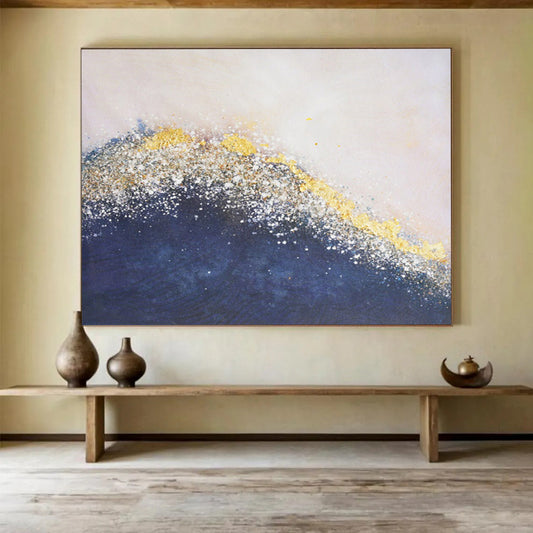
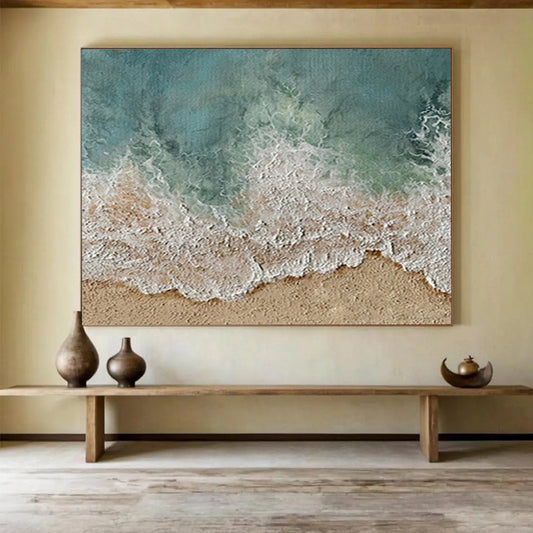
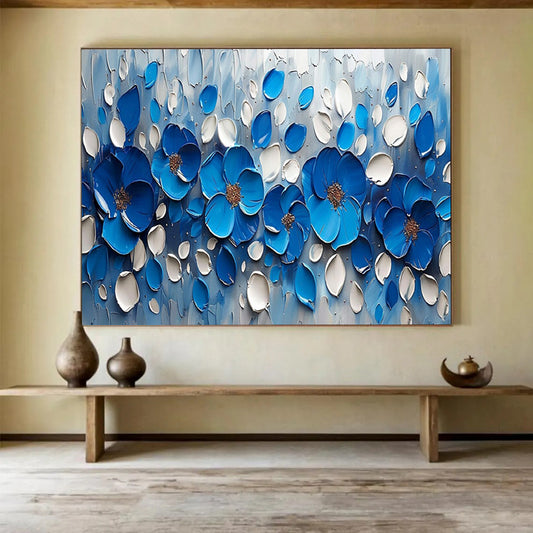
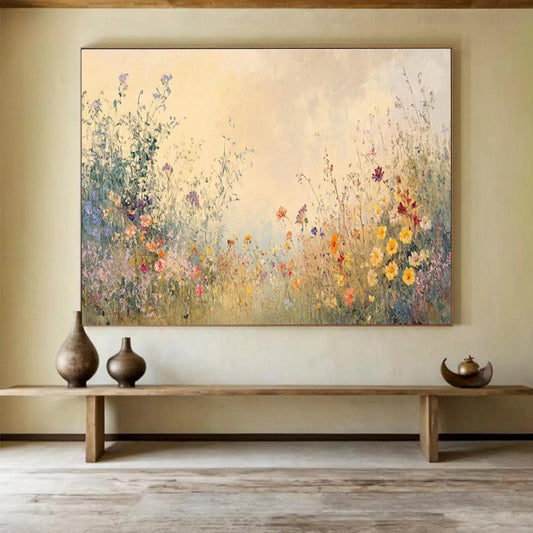
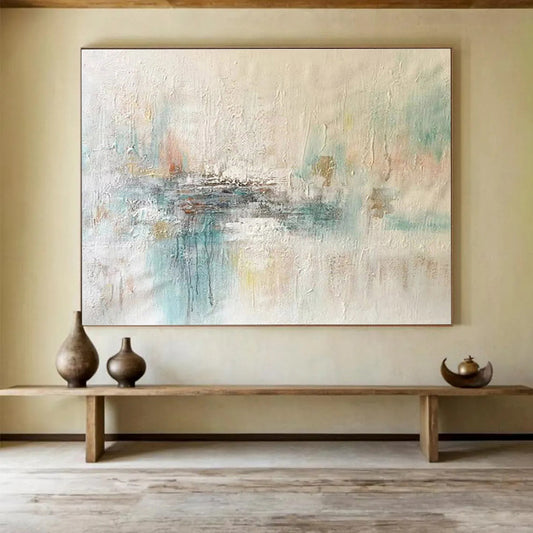
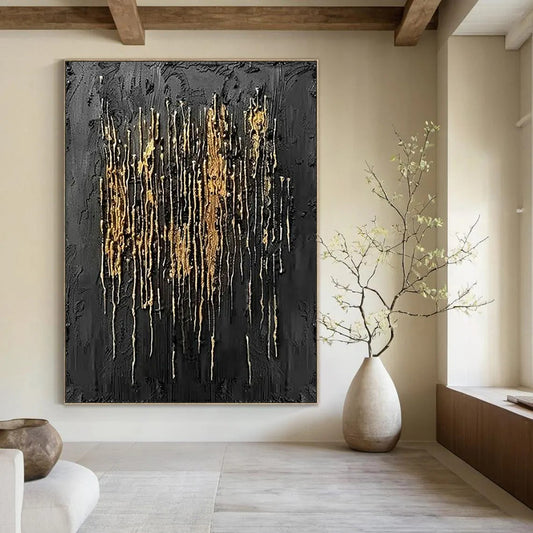
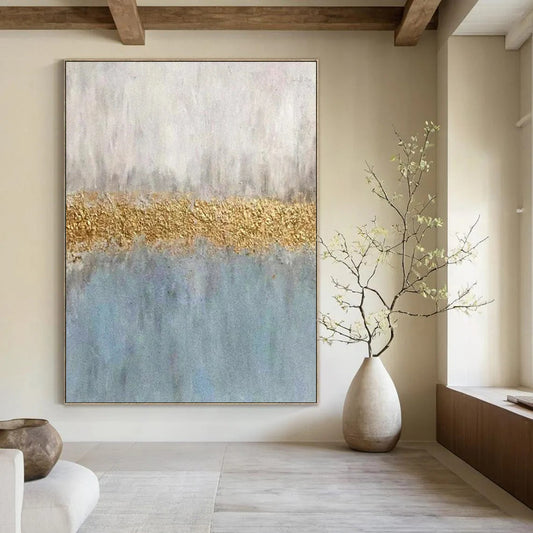
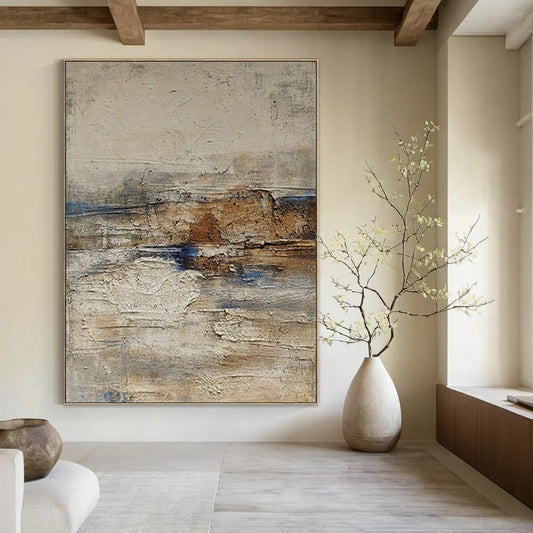
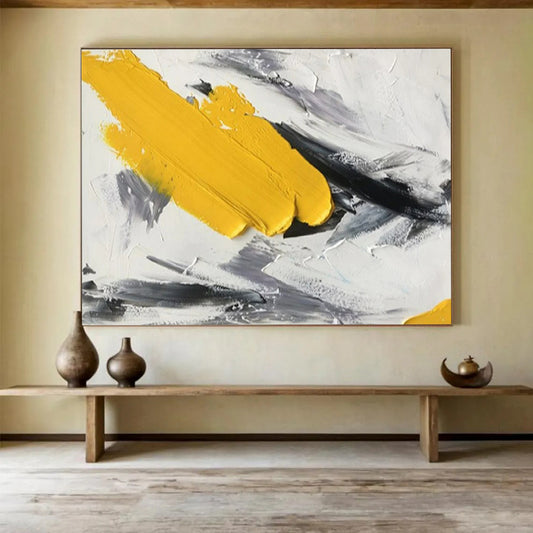
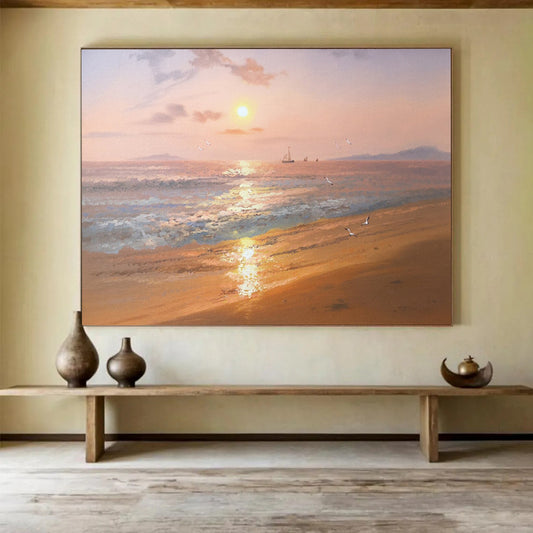
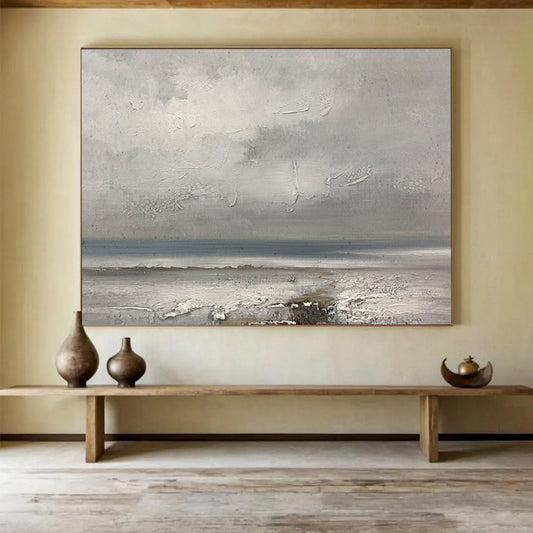
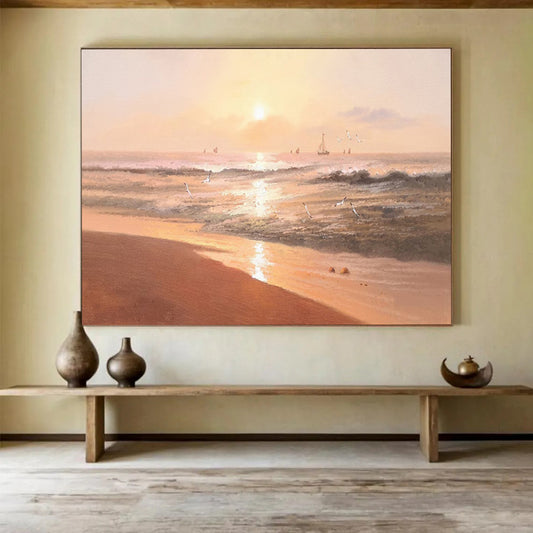
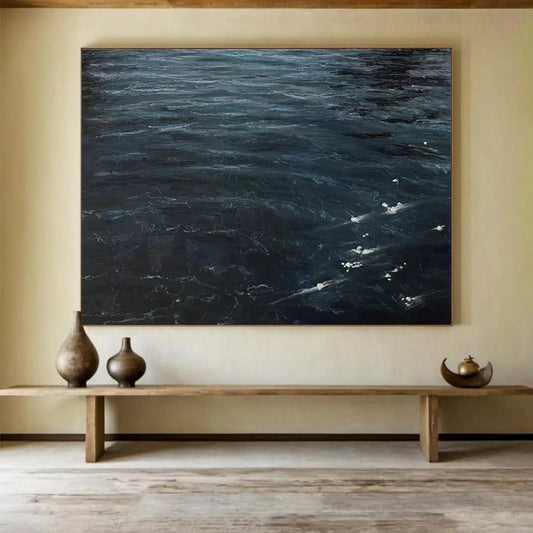
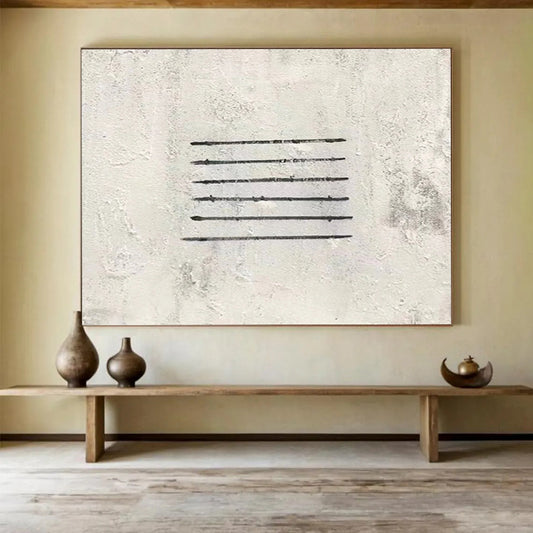
Collection: Living Room Wall Art

Living room wall art is a seating-line decision: one handmade canvas that finishes the span above the sofa, so the empty rectangle does not look leftover. These pieces are painted to order—fields, quiet geometry, a climate large enough for an evening—not a beach print scaled up. Measure the furniture width first. Browse below and send that span if standard sizes miss.
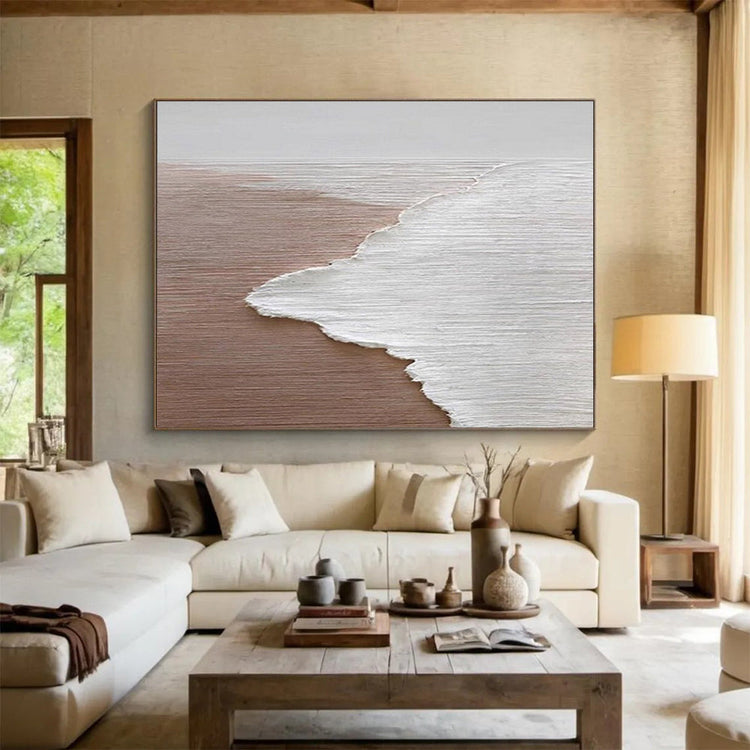
Living Room Wall Art

How to Choose Living Room Wall Art That Can Sit Through an Evening

A living room is a room of duration. People sit, talk, look up from a phone, leave, and come back. Living room wall art has to survive that evening without becoming a second television. A timid square in the middle of a long sofa span looks like a sample. A beach postcard labeled “statement” looks like a holiday that will not last until February.

Living Room Wall Art in this collection means hand-painted canvas for the wall the seating faces: textured fields, gold on a crest, a quieter gray horizon, a botanical plane. The listing is a climate. The piece you receive is painted to order in that climate, not a printed panel scaled up until the pixels show.

Two ways a large wall has been finished

Tate’s glossary on abstract expressionism splits the problem in a way that still maps onto a sofa wall. One group attacked the canvas with gesture. The other filled it with large areas of color meant to hold a slower look. A living room can take either. It cannot take both at once if the marks are already fighting the rug.

Gesture wants a wall that can carry energy without a caption: a scraped wave, a black-and-gold field, a few thick strokes that still read from the far chair. Colour-as-climate wants the opposite discipline. Navy, clay, ash, a horizon that does not need a cottage. If you have to name the scene for the picture to work, it is a view wearing an abstract title.

MoMA’s Colors for a Large Wall is the scale test, not a shopping model. Ellsworth Kelly built a plane almost eight feet square so the wall itself became the event. No personal handwriting. The title says what the object is for: a large wall. You are not buying a grid of sixty-four panels. You are borrowing the refusal. Extra-large living-room art should occupy the empty rectangle. It should not float in the middle of it like a poster.

Tate’s note on abstract art is the useful warning about the other failure. Abstraction can simplify a landscape until only climate remains, or it can invent forms with no view at all. Both are legitimate. A turquoise beach with a named shore is neither. Take the word “coastal” off the product title. Does a structure remain—a ridge, a split, a field—or only a souvenir?

A working split for this grid:

  • Open lounge: one horizontal plane that takes most of the sofa width.
  • Compact family room: a quieter field, mid values, less gold.
  • Gold-and-navy wave: a heat decision. Right if the wood is already dark. Wrong if the room is already orange.
  • Floral 3D and pastel reverie: a figure, not a sofa climate. Better on a pier than across eight feet of seating.

Measure the seating line before you shop the grid

Stand where people actually sit. Photograph the empty span at the hour you use the room—afternoon window, evening lamps, the television if it shares the wall. Measure three things: the width of the furniture plane, the height from the top of the back cushions to the ceiling line you want to keep clear, and the competition. A screen and an extra-large canvas on the same plane usually fight. Give one of them the wall.

Give the canvas most of that furniture width so leftover drywall does not frame it like a stamp. Leave a gap above the sofa so heads and lamps do not collide with the frame. If the ceiling is ordinary, a horizontal field fits. If the unused space is a tall strip beside the seating—not the sofa face itself—use a vertical plane.

Light in a living room is messy. Side light shows handmade ridges. A downlight on pale gold peaks turns scale into glare. Mid values and a quieter sheen are easier at night and on camera. Match temperature to wood and the large upholstery, not to one pillow. Oak sits with clay, olive, and sand. Gray seating sits with ash, slate, and muted teal. Navy and gold want a room that can take metal. A small family room with pale walls usually cannot.

Texture is the advantage and the risk. Knife paste catches the afternoon and dies as a printed photograph of paste. High brittle crests above a busy sofa collect dust and catch shoulders. Mid relief is enough for most seating walls. Ask whether deep build ships rolled or stretched.

What this wall should refuse

Refuse the second television of busy marks. Refuse a tiny picture centered on a long sofa. Refuse a canvas that only works in a product photo with the furniture removed. Handmade layers are the reason to order paint: a trough that goes darker as you walk, a crest that is not one digital gold. Look for angled close shots, oil or acrylic on canvas, painted to order. Approve photos before it ships. Custom width exists for the span you measured—not for the size that looked fine in a grid.

A short buying order

  1. Photograph the seating wall at the hour you use it.
  2. Measure the furniture width and the height above the sofa.
  3. Decide gesture or field—not a named beach.
  4. Keep the television on a different wall if you can.
  5. Match temperature to wood and the large fabric.
  6. Review photos of the finished canvas before it ships.

Living room wall art is a seating-line decision. One handmade plane, sized to the empty rectangle, finishes the evening. Two competing statements do not.

Should living room art go above the sofa or opposite it?

Above the sofa if that span is empty and you want the room to read as finished from the door. Opposite the seats if that is the wall people actually look at and the sofa wall is already glass or a screen.

Can one canvas work in an open-concept lounge?

Yes, if it occupies the furniture span and the chroma stays quieter than the kitchen beyond. An open plan already has too many objects. The art should be one climate, not a second room.

Will gold texture overwhelm a small family room?

Often. A thin note of gold on a gray or navy field can hold. Gold on every crest in a compact room reads as a showroom. Ask for less metal if the listing runs trophy-bright.

How do I keep the art from matching the throw pillows?

Share a temperature with the wood and the large upholstery, not with one cushion. Pillows change. The canvas should still make sense when they do.

Is a beach scene the same as abstract living room art?

No. A named shore is a view. Abstract living-room work keeps structure—ridge, split, field—after the place-name is removed.

Can I order a width that matches the sofa?

Yes. Send the sofa width, the wall width, and a daytime photo. Keep the same climate as the listing, and approve images of the finished surface before shipping.