Collection: Abstract Painting Minimalist
Abstract painting minimalist here means an original canvas carried by proportion, edge, and a few values, not a pale print enlarged until the marks vanish. A reduced field should hold the wall and still leave interval around it. Band width, ground temperature, and scale can be set to the room before the canvas is stretched.
-
Blue & Gold Abstract Divide - Minimalist Abstract Painting On Canvas CT2289
Regular price From $219.00 USDRegular priceUnit price / per$395.00 USDSale price From $219.00 USDSale -
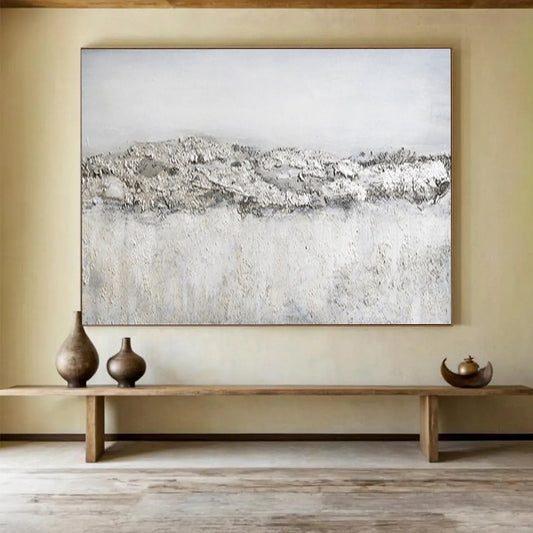
“Textured Gray Horizon” - Gray & White Minimalist Abstract Painting On Canvas DLZ260
5.0 / 5.0
(3) 3 total reviews
Regular price From $219.00 USDRegular priceUnit price / per$395.00 USDSale price From $219.00 USDSale -
“Soft Pastel Shapes” Minimalist Abstract Painting On Canvas DLZ132
Regular price From $219.00 USDRegular priceUnit price / per$395.00 USDSale price From $219.00 USDSale -
“Subtle Tones Abstract Geometry” Minimalist Abstract Painting On Canvas DLZ097
Regular price From $219.00 USDRegular priceUnit price / per$395.00 USDSale price From $219.00 USDSale -
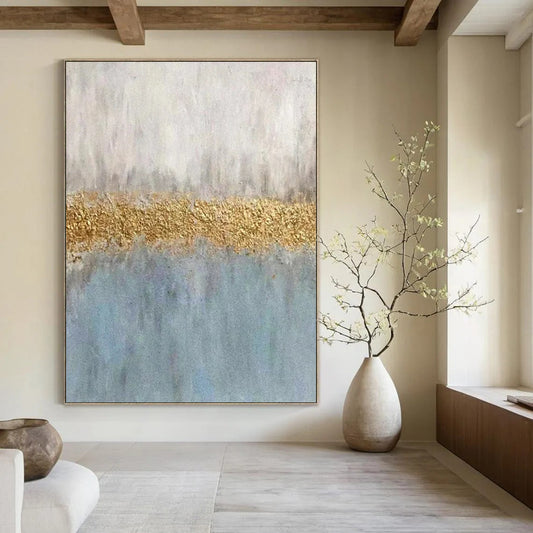
“Soft Tones Geometric Abstraction” Minimalist Abstract Painting On Canvas DLZ092
Regular price From $219.00 USDRegular priceUnit price / per$395.00 USDSale price From $219.00 USDSale -

“Yellow, White Minimalist Shape ‘Sunny Simplicity’” - Textured Abstract Painting On Canvas DTP340
Regular price From $219.00 USDRegular priceUnit price / per$395.00 USDSale price From $219.00 USDSale -
“Two Swimmers in Green” - Green, Blue, Red Minimalist Figurative Painting On Canvas DTP305
Regular price From $219.00 USDRegular priceUnit price / per$395.00 USDSale price From $219.00 USDSale -
“Soft Gray - Pink Paint Strokes Stack” - Minimalist Color Field Painting On Canvas DTP184
Regular price From $219.00 USDRegular priceUnit price / per$395.00 USDSale price From $219.00 USDSale -
“White - Gray Textured Minimalism” - Minimalist Abstract Painting On Canvas DTP147
Regular price From $219.00 USDRegular priceUnit price / per$395.00 USDSale price From $219.00 USDSale -
“White Flowers on Black” - Minimalist Floral Painting On Canvas DTP140
Regular price From $219.00 USDRegular priceUnit price / per$395.00 USDSale price From $219.00 USDSale -
“White - Gray Textured Wall” - Minimalist Abstract Painting On Canvas DTP066
Regular price From $219.00 USDRegular priceUnit price / per$395.00 USDSale price From $219.00 USDSale -
“Pastel Geometric Blocks” - Minimalist Color Field Painting On Canvas DTP013
Regular price From $219.00 USDRegular priceUnit price / per$395.00 USDSale price From $219.00 USDSale -
“White Plaster - Like Textures” - Minimalist Abstract Painting On Canvas DKH1673
Regular price From $219.00 USDRegular priceUnit price / per$395.00 USDSale price From $219.00 USDSale -
“Sunny Yellow & Ocean - Blue Stripes” - Minimalist Color - Block Painting On Canvas DKH1623
Regular price From $219.00 USDRegular priceUnit price / per$395.00 USDSale price From $219.00 USDSale -
“Reddish - Orange Color Field” - Minimalist Color Field Painting On Canvas DKH1613
Regular price From $219.00 USDRegular priceUnit price / per$395.00 USDSale price From $219.00 USDSale -
“White Textured Stillness” - Gray & White Minimalist Textured Painting On Canvas DKH1581
Regular price From $219.00 USDRegular priceUnit price / per$395.00 USDSale price From $219.00 USDSale
A Blank Wall Is Not a Minimalist Painting
A blank wall is not a minimalist painting. That confusion is why this category is usually written as a shopping filter: pale grounds, thin lines, nothing that will clash with a linen sofa. The filter is not the work. A reduced painting is a decision about how little a surface can carry and still hold a room. Remove one interval too many and it becomes drywall with a frame.
The art-historical term is stricter than the interior one. Tate describes Minimalism as an extreme form of abstract art, typified by simple geometric shapes based on the square and the rectangle, in which the viewer is asked to respond only to what is in front of them. Frank Stella’s line, recorded there, still cuts through the decor version: what you see is what you see. MoMA characterizes the movement by simple geometric forms devoid of representational content. There is no story waiting behind the bands. The bands are the content. Agnes Martin, whose grids and stripes the Guggenheim traces across more than forty years, shows the other half of the lesson. Her paintings are quiet, and they are not empty. A penciled grid on a large square is an event of interval. Stand close and the line wavers. Step back and the field settles. That double reading is the whole point of a handmade reduced surface.
Abstract Painting Minimalist, in the handmade sense used here, means an original painting whose order is carried by proportion, edge, and a very small number of values. It does not mean a gray file enlarged until the marks disappear. The category fails when “minimal” is used as permission to stop composing.
Reduction is a craft problem, not a mood. In a gestural canvas, a weak passage can hide inside incident. In a minimalist abstract painting there is nowhere to hide. A horizon band that sits a finger too high reads as a mistake. A square that is almost, but not quite, related to the wall reads as unfinished. Two near-whites that were separated on a screen often collapse into one value under north light. Custom work exists to settle those distances before the canvas is stretched: the width of a band, the temperature of a ground, the amount of tooth the line needs in order to stay visible at six feet and present at two.
Measure the wall’s unused space before you measure the painting. A reduced work should not fill the wall the way a mural does. It should set a proportion against the wall and leave the rest as interval. Above a low sofa, a wide horizontal canvas with one or two bands often steadies the room better than a cluster of small frames. On a tall wall, a single near-square, hung with air above and below, usually reads as intentional. A short piece floating in a high bay looks like a placeholder. Large minimalist painting is a scale decision, not a bigger version of a small motif.
Color is the next place the category is misunderstood. Restraint is not a beige rule. A mineral gray, a warm off-white, a dulled blue-green, a single iron line: each can be minimal if the number of competing events stays low. What breaks the order is a second accent that asks to be noticed on its own. If the room is already full of stone, oak, and undyed cloth, the painting’s job is not to add a color story. It is to give the wall a measured edge so the quiet materials do not blur into one another. A slightly warm ground will also keep the canvas from looking like a sample of the paint already on the wall.
Surface is the reason to commission rather than print. A printed geometric image is the same at every distance. An original minimalist canvas is not. A hand-drawn line thickens and thins. A glazed ground shifts when sidelight moves across the afternoon. Those changes are small, and they are the difference between a panel and a painting. A heavy impasto all over the field usually fights this kind of work; it turns reduction into texture for its own sake. A slight tooth, a layered ground, an edge that was painted rather than cut by a file, is enough.
Hang the work so the main interval lines up with something already in the room: the top of a door, the line of a console, the seat-back height of the sofa. The painting then belongs to the architecture instead of hovering as an object on approval. Leave more margin than you think you need. Minimalist wall art dies when it is crowded by a lamp, a plant, and a second frame competing for the same silence.
Commissioning is specific. Name the wall width, the ceiling height, the light direction, and the one relationship you want: a single band, a faint grid, two close values, a square inside a rectangle. Then stop. Extra motifs are how a reduced painting becomes a diagram of reduction, which is a different and weaker thing. From the doorway, one shape. From the chair, a line or a value shift you did not see at first. That is the narrow job of a handmade minimalist painting, and it is harder than filling a canvas.
FAQ
What makes a painting minimalist rather than merely plain?
A plain canvas has little on it. A minimalist abstract painting has a decided order carried by proportion, edge, and a very small number of values. The intervals are composed. A blank or near-blank field with no measurable relationship to the wall is unfinished, not reduced.
Does abstract painting minimalist mean only white, gray, and beige?
No. Restraint is a limit on competing events, not a ban on hue. A dulled blue-green, a warm off-white, or a single iron line can be minimal. The order breaks when a second accent asks to be noticed on its own.
Why commission a minimalist canvas instead of printing a geometric file?
A reduced image hides nothing. Band width, edge, and close values that look separate on a screen often collapse in real light. A handmade ground and a hand-drawn line also change slightly with viewing distance. A print stays identical at every distance, which is why large printed minimalist art often reads as a panel.
How large should a minimalist painting be on a tall wall?
Do not fill the height. A near-square or a tall narrow canvas, hung with clear air above and below, usually reads as intentional. A short wide piece floating in a high bay looks like a placeholder. Scale here means the painting’s proportion against unused wall, not the biggest size available.
Where does textured paint help, and where does it hurt?
A slight tooth or a layered ground helps, because sidelight needs something to catch or the field goes flat. Heavy impasto across the whole surface usually hurts. It turns the painting into a texture sample and competes with the interval that was supposed to be the subject.


